Northern Wei, China
Chao Jizi (Northern Wei Scrambled Eggs with Scallions and Fermented Beans)
An early recorded egg dish stir-fried in sesame oil with white scallions and fermented black soybeans, from the 6th-century Northern Wei agricultural manual Qimin Yaoshu. Distinguishes documented methods from modern proposed timings.
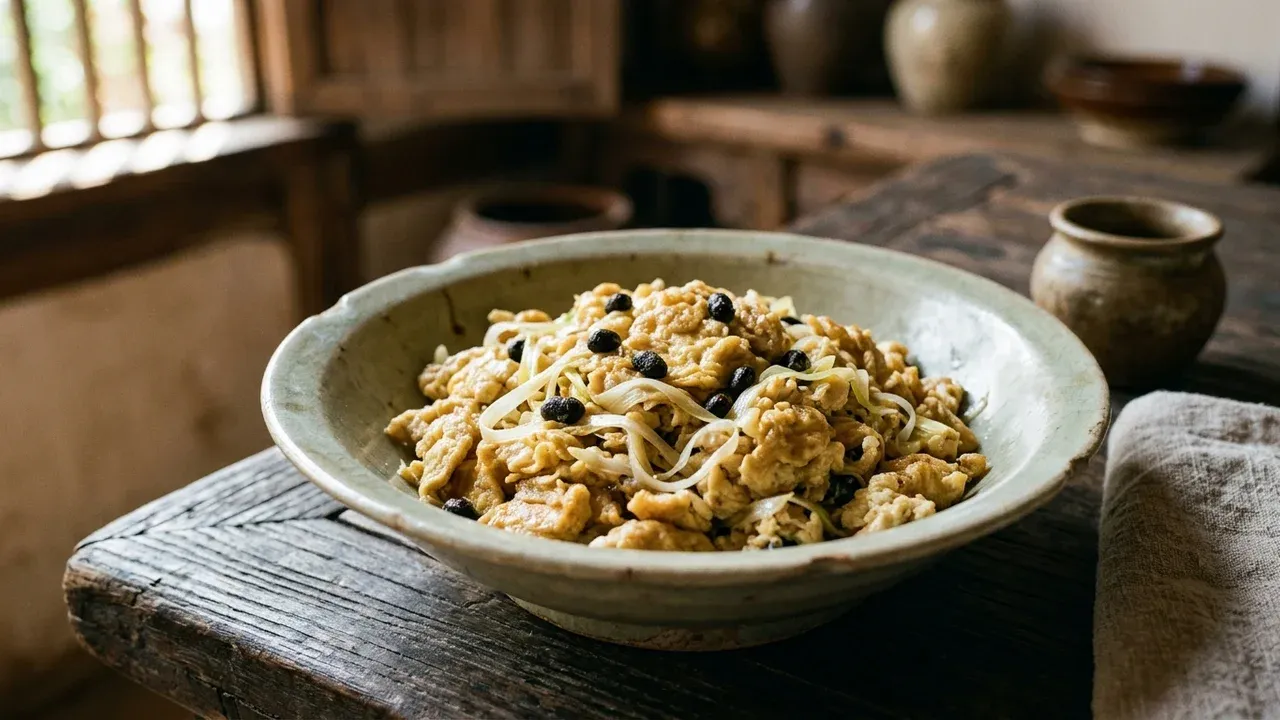
MODERN RECREATION
Modern Adaptation Proposal
Ingredients
Instructions
- Crack the eggs into a bowl and whisk thoroughly until the whites and yolks are fully combined.
- Finely shred the white parts of the scallions along the grain. Keep the fermented black soybeans whole without crushing.
- Heat a frying pan over medium heat, add the sesame oil, and briefly sauté the scallions and whole black soybeans for 30 to 60 seconds over medium-low heat to infuse the oil with aroma.
- Pour in the beaten eggs and salt, stirring vigorously with a spatula in broad folding motions to create soft, fluffy curds.
- As soon as the eggs are fully set and cooked through to the center, remove from heat immediately to prevent overcooking and transfer to a serving plate.
- Serve warm promptly; do not leave at room temperature for extended periods.
HISTORICAL RECORD
Historical Sources and Evidence
These sources provide historical context. They do not necessarily support the quantities or cooking times in the modern adaptation.
Statements supported by sources
Recorded at the end of Book 6, Section 57 of Qimin Yaoshu as 'Chao Jizi Fa', describing cracking eggs into a shallow pan, mixing yolks and whites together, adding finely shredded scallion whites, salt (yanmi), whole fermented black soybeans (hunchi), and stir-frying with sesame oil.
The original text concludes by praising the dish as 'shen xiang mei' (extremely fragrant and delicious).
Inference and interpretation
- Agricultural and linguistic scholars widely interpret 'yanmi' as coarse grains of salt or a pinch of salt due to the resemblance of salt crystals to rice grains.
- 'Hunchi' indicates whole fermented black soybeans, used intact rather than mashed or pressed for liquid.
- The 6th-century 'cheng' was a shallow tripod or flat-bottomed pan rather than a modern deep round wok, suggesting quick stirring over a flat heated surface.
- The source specifies no exact quantities, weight ratios, or cooking seconds; the modern recipe proportions are an untested proposal.
Modern adjustments
- The quantities of 3 eggs, 30g scallions, 5g fermented black beans, 1 tbsp sesame oil, and 0.5g salt are an untested home adaptation for 2 servings.
- Pan temperatures and cooking timings are guidelines and have not been validated through actual kitchen testing.
- Food safety: Cook eggs thoroughly until firm and heated through to an internal temperature of at least 71°C (160°F / 75°C for 1 min); do not leave lightly cooked eggs at room temperature.
- Allergen information: Contains eggs, soy (fermented beans), and sesame (oil).
Sources and references
- 齊民要術 巻第六・養雞第五十七「炒雞子法」Open source: https://zh.wikisource.org/wiki/%E9%BD%8A%E6%B0%91%E8%A6%81%E8%A1%93/%E5%8D%B7%E7%AC%AC%E5%85%AD
Primary source text. Comprehensive 6th-century agricultural work by Jia Sixie (Northern/Eastern Wei). Inspected the electronic transcription of Chao Jizi Fa at the end of Book 6, Section 57. The original 6th-century physical manuscript does not survive and was not inspected.
- USDA FSIS, Shell Eggs from Farm to TableOpen source: https://www.fsis.usda.gov/food-safety/safe-food-handling-and-preparation/eggs/shell-eggs-farm-table
Modern food safety guidance. Minimum internal cooking temperature of 160°F (71°C) for egg dishes, prompt refrigeration within 2 hours, and safe shell egg handling.
- 厚生労働省「家庭での食中毒予防」Open source: https://www.mhlw.go.jp/stf/seisakunitsuite/bunya/kenkou_iryou/shokuhin/syokuchu/01_00008.html
Modern household hygiene guidance: thorough cooking through the center, clean utensils, and eating promptly after preparation.
Image credits and sources
© History Meshi (AI-generated recreation image / AI生成による再現イメージ)
Source: Modern adaptation concept based on Qimin Yaoshu, Book 6, §57 (c. 533–544 CE) / 『齊民要術』巻第六「炒雞子法」(6世紀北魏)に基づく現代向け再現案の料理イメージ
License: Original site asset (not an actual cooking or historical source photograph / 実調理・史料写真ではありません)