Abbasid Baghdad (1226)
Medieval Baghdadi Sikbaj
The premier dish opening the 1226 Baghdadi culinary manual 'Kitāb al-Ṭabīkh'. Tender lamb simmered in a sweet-and-sour broth of wine vinegar and date syrup (or honey), featuring saffron, carrots, dried figs, raisins, almonds, and the floral fragrance of rose water from the Islamic Golden Age (an untested home adaptation).
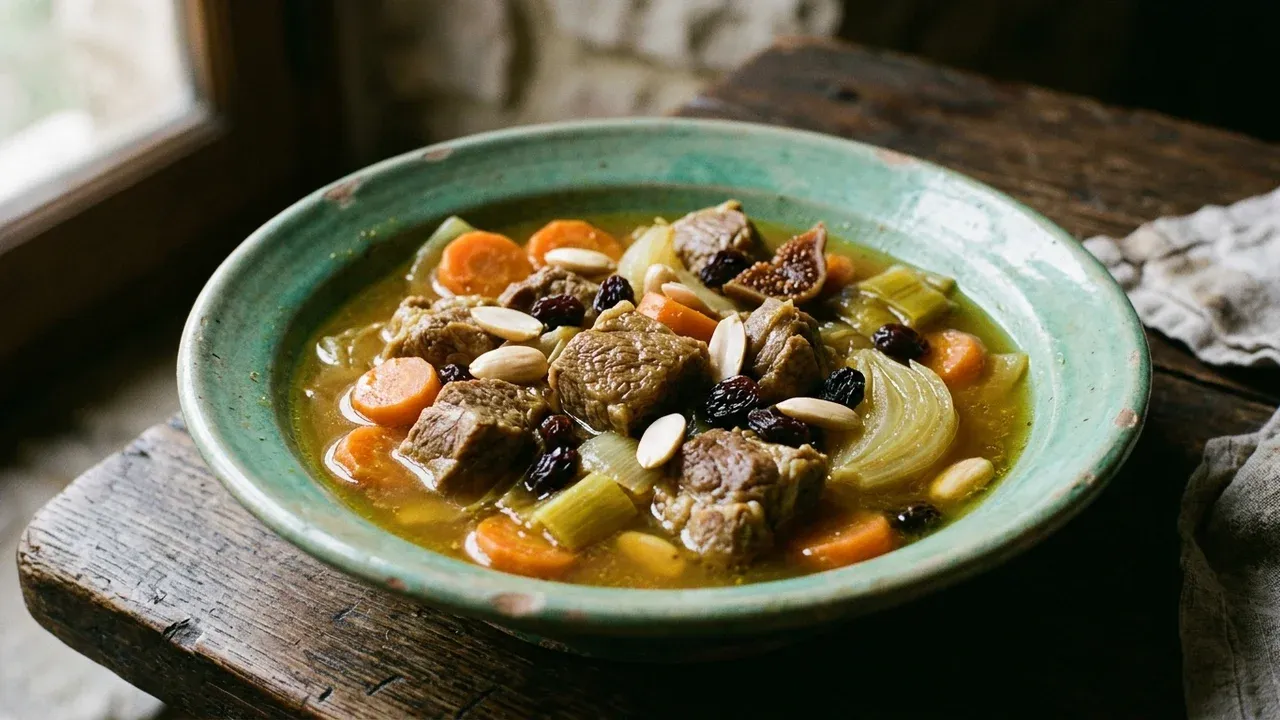
MODERN RECREATION
Modern Adaptation Proposal
Ingredients
Instructions
- Place cubed meat, water, fresh coriander, cinnamon stick, and salt in a saucepan over medium heat. When boiling, carefully skim away all froth and surface fat.
- Remove and discard the fresh coriander sprigs, then add ground coriander, white onion, leek, and carrots.
- Mix white wine vinegar and date syrup (or honey) together to ensure a balance midway between sharp and sweet, then pour into the pot. Cover and simmer over low heat for 50–60 minutes until the meat is tender. (Note: If using honey, never feed it to infants under 1 year of age, as cooking heat does not destroy botulism spores.)
- Ladle out a little cooking broth, combine with the steeped saffron water, and pour back into the pot to blend (in this modern recreation, saffron is expected to impart a rich golden-amber broth).
- Scatter almonds, raisins, and quartered dried figs neatly over the top. Cover tightly and let steam over very low heat for about 15 minutes to allow flavors to meld.
- Carefully wiping the saucepan rim with a clean cloth while guarding against steam and heat burns, sprinkle rose water over the surface, and remove from heat to serve.
HISTORICAL RECORD
Historical Sources and Evidence
These sources provide historical context. They do not necessarily support the quantities or cooking times in the modern adaptation.
Statements supported by sources
Documented as 'Sikbāj' in Recipe 1, Chapter 1 ('Sour Dishes') of Muhammad ibn al-Hasan al-Baghdadi's 1226 culinary manual 'Kitāb al-Ṭabīkh', directing that fat meat be boiled with water, fresh coriander, cinnamon bark, and salt, skimmed, and that fresh coriander then be replaced with dry coriander.
Specifies adding white onions, Syrian leeks, and carrots if in season (or parboiled eggplant), followed by pouring in wine vinegar and date juice (or honey, with date juice noted as more suitable) mixed midway between sharp and sweet.
Records that when ready to remove from heat, a little broth is taken out, saffron is brayed into it and poured back, peeled split sweet almonds, raisins, currants, and dried figs are placed on top, the pan is covered to settle over the heat, the sides wiped with a clean cloth, and rose water sprinkled on top.
The presence of a chapter dedicated to sikbāj in Ibn Sayyār al-Warrāq's earlier 10th-century 'Kitāb al-Ṭabīkh' is confirmed in scholarly bibliography (critical edition bibliography verified; Chapter 49 text unexamined directly).
Inference and interpretation
- Derived from the Persian 'sikbā' ('vinegar stew'), representing Sasanian royal culinary techniques adapted into the sophisticated court gastronomy of Abbasid Baghdad.
- The Arabic term 'as-sikbāj' is recognized linguistically as the ancestor of the Spanish 'escabeche' via Moorish Iberia (as documented in dictionaries such as the Real Academia Española). However, modern escabeche encompasses a diverse range of marinated fish, meat, or vegetables, and differs substantially in cooking technique and culinary role from this medieval warm meat stew.
- While date juice ('dibs') is explicitly preferred in the primary source, this modern adaptation uses commercial date syrup or natural honey to approximate the historical sweet-and-sour profile, without asserting an exact reproduction of the original medieval flavor.
Modern adjustments
- [Modern Adaptation and Adjustments (untested)] The historical recipe in Arberry's translation specifies boiling for an hour after adding vinegar and sweetener ('boil for an hour'), and then covering for an hour over the heat of the fire to settle ('Cover for an hour'). In this home adaptation, cooking times have been deliberately shortened and modified to 50–60 minutes of gentle simmering and 15 minutes of steaming to suit modern household cookware and heat sources. Exact metric weights (400g meat, 80 mL vinegar, 50g syrup) are modern estimates not specified in the original text. Vinegar and sweetener are added earlier with vegetables to ensure even infusion, and currants were merged into standard raisins and dried figs for market availability.
- [Ingredient Substitutions] Lamb or beef stew meat is used for the unspecified 'fat meat', and common leek (or Welsh onion/scallion) replaces Syrian leek. Carrots were selected from the seasonal alternatives (carrots or eggplant) for year-round accessibility and dependable braising texture.
- [Food Safety and Hygiene] Follows official food safety standards requiring meat to reach an internal core temperature of at least 75°C for 1 minute, with strict utensil separation to prevent cross-contamination between raw meat and vegetables, garnishes, or finished food. Promptly refrigerate below 10°C after cooling; do not leave at room temperature despite the vinegar and sweetener content.
- [Honey, Allergen, and Burn Warnings] If honey is used, never feed it to infants under 1 year of age, as normal cooking and simmering temperatures do not destroy Clostridium botulinum spores. Check for tree nut (almond) allergies. Exercise caution against burns from hot steam, boiling broth, and when wiping the rim of the hot pan with a cloth.
Sources and references
- 『Kitāb al-Ṭabīkh(料理の書)』第1章第1処方「Sikbāj」Open source: https://archive.org/details/in.ernet.dli.2015.91880
Consulted via A. J. Arberry's English translation in 'Islamic Culture' Vol. 13 (1939, p. 34, Internet Archive), based on the 1226 manuscript (Süleymaniye Library MS Ayasofya 3710), Chapter 1, Recipe 1. Charles Perry's 2005 edition was verified for bibliographic data only (recipe text unexamined). Direct collation of the Arabic manuscript was not performed.
- 『Kitāb al-Ṭabīkh』第49章「シクバージの章」Open source: https://brill.com/display/title/12145
10th-century Abbasid cookbook; bibliography confirmed via Nawal Nasrallah's critical English edition 'Annals of the Caliphs' Kitchens' (Brill, 2007, ISBN 978-90-04-15867-2; bibliography verified, full chapter text unexamined). Cited as a comparative bibliographic reference for earlier eggplant-based variants and court lore.
- Real Academia Española: Diccionario de la lengua española — «escabeche»Open source: https://dle.rae.es/escabeche
Etymological entry for 'escabeche' in the Diccionario de la lengua española (Real Academia Española), confirming derivation from Arabic 'as-sikbāj'.
- 厚生労働省「お肉はよく焼いて食べよう」食品安全情報Open source: https://www.mhlw.go.jp/stf/seisakunitsuite/bunya/0000049964.html
Meat hygiene standards: ensure meat reaches an internal core temperature of at least 75°C for 1 minute, and prevent cross-contamination between raw meat tools and finished foods or nuts.
- 厚生労働省「ハチミツを与えるのは1歳を過ぎてから。」Open source: https://www.mhlw.go.jp/stf/seisakunitsuite/bunya/0000161461.html
Official health guidance on infant botulism prevention: Clostridium botulinum spores in honey are not destroyed by ordinary cooking or boiling; honey or foods containing honey must never be fed to infants under 1 year of age.
Image credits and sources
© History Meshi (AI-generated recreation image / AI生成による再現イメージ)
Source: Modern adaptation concept based on Kitāb al-Ṭabīkh (1226) / 『Kitāb al-Ṭabīkh(料理の書)』(1226年)に基づく現代向け再現案の料理イメージ
License: Original site asset (not an actual cooking or historical source photograph / 実調理・史料写真ではありません)