Qing Dynasty China (1792)
Hongwei Rou (Suiyuan Shidan Red-Braised Pork)
Based on 'Three Methods for Red-Braised Pork' in Yuan Mei's Suiyuan Shidan (1792), this article presents pork belly slow-braised in rice wine, soy sauce and a little salt without caramelized sugar or star anise, separating Su Shi's Northern Song 'Ode to Pork' and historical uncertainties from a modern home adaptation.
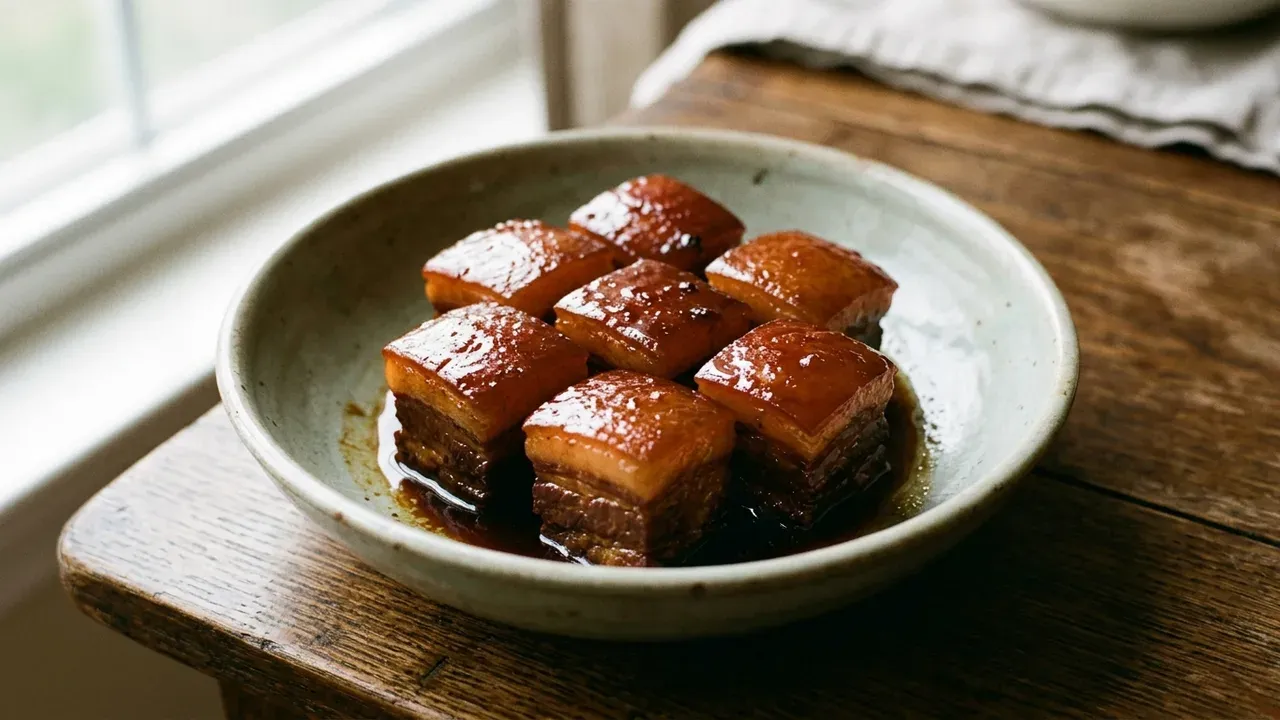
MODERN RECREATION
Modern Adaptation Proposal
Ingredients
Instructions
- Do not rinse raw pork belly in the sink (to avoid spreading bacteria); pat dry with paper towels, trim any tough sinew membranes, and cut into roughly 3.5–4cm cubes. Immediately wash hands, knives and cutting boards that touched raw pork.
- Arrange the pork snugly in a single layer (skin-side down if skin-on) in a heavy small pot or clay pot (about 16–18cm diameter). Pour in 250mL Shaoxing wine, 20mL soy sauce and 1.5g salt. Following the source's admonitions, add no water, sugar or spices.
- Bring to a boil over medium heat and skim off surface scum. Cover with a tight-fitting lid, reduce to the lowest simmer where the liquid barely trembles, and braise for an initial guide of 60–75 minutes without lifting the lid repeatedly (if the liquid reduces too quickly depending on lid fit and heat, add about 30–50mL of hot water to prevent boiling dry or scorching).
- Watching carefully against boiling dry or scorching, remove the lid and verify thorough cooking to the centre (at least 75°C at the thickest part for 1 minute or more as the unified hygiene standard). If the edges of the pork are not yet tender, add a splash of hot water and continue simmering gently.
- Simmer uncovered over low to medium-low heat for 5–10 minutes while swirling the pot until the liquid reduces into a glossy reddish-brown glaze. Guard against burns from steam, hot glaze and handles; serve with clean utensils, do not leave at room temperature, and chill leftovers promptly in shallow containers at 4°C or below.
HISTORICAL RECORD
Historical Sources and Evidence
These sources provide historical context. They do not necessarily support the quantities or cooking times in the modern adaptation.
Statements supported by sources
In the Pork section (Tesheng Dan) of Yuan Mei's Suiyuan Shidan (published in 1792, Qianlong 57), 'Three Methods for Red-Braised Pork' (Hongwei Rou San Fa) records braising pork either with sweet bean paste (tianjiang), with autumn soy sauce (qiuyou), or without either—using 3 qian of salt per jin of pork and braising in pure rice wine (or with water that is boiled down until its watery moisture is gone).
The entry states that all three methods yield a glaze as red as coloured glass (liuli) and strictly forbids adding caramelized sugar for colour (buke jia tang chaose). It warns that removing the pot too early leaves the pork yellow while cooking too long turns it purple and makes the lean meat hard, that lifting the lid often lets the fat and flavour escape, and that square-cut pork should be simmered over gentle heat ('rapid fire for congee, slow fire for meat') until its sharp edges disappear and the lean meat melts in the mouth.
In the Essential Knowledge section (Xuzhi Dan) of the same work, Yuan Mei advises choosing thin-skinned pork free of rank odour, trimming sinew membranes so the meat becomes tender, using gentle heat for braising without repeatedly opening the lid, never using caramelized sugar for colour or spices for aroma, and using clay pots (shaguan) for slow braising.
Su Shi's Northern Song poem 'Ode to Pork' (Zhurou Song) describes cooking inexpensive Huangzhou pork in a cleanly washed pot with little water over suppressed embers without high flames until it becomes tender in its own time, but mentions no wine, soy sauce, salt or quantities.
Inference and interpretation
- This article inspected electronic transcriptions of Suiyuan Shidan and 'Ode to Pork' on Wikisource; character-by-character collation against the 1792 woodblock edition or Song printings was not performed.
- In 'Hongwei Rou San Fa', whether the ratio '3 qian of salt per jin of meat, braised in pure wine' applies only to the third method (without soy sauce or sweet paste) or serves as a baseline across all three is open to syntactic interpretation, and exact volumes of autumn soy sauce, sweet paste and wine are not specified.
- Qing dynasty weights (roughly 597g per jin and 3.7g per qian) and the salinity, sugar content and colour of 18th-century autumn soy sauce, sweet bean paste and fermented rice wine cannot be equated with modern commercial products. How red the salt-and-wine-only version became likely depended on the sugars and colour of the traditional rice wine used.
- While Su Shi's 'Ode to Pork' is widely cited as the literary forerunner of Dongpo pork and slow low-liquid pork braising, the poem itself neither uses the name Dongpo pork nor specifies wine or soy sauce, so it cannot be treated as identical to Yuan Mei's Hongwei Rou.
Modern adjustments
- This untested home proposal for 2–3 servings adapts the second method of 'Hongwei Rou San Fa' (braising with soy sauce and wine), using 400g pork belly, 250mL Shaoxing wine, 20mL soy sauce and 1.5g salt. Following Yuan Mei's explicit rules against caramelized sugar and added aromatics, sugar, star anise, ginger and scallions are omitted.
- Because 'Hongwei Rou San Fa' does not mention parboiling (unlike several other pork entries in Suiyuan Shidan), the pork is braised directly in wine and soy sauce without prior blanching. The total estimated time of 80–100 minutes (10 minutes prep, 60–75 minutes covered simmering, 5–15 minutes reduction), tenderness, salt balance, scorching risk and glaze colour remain untested.
- Food safety (modern guidance): thaw frozen pork in the refrigerator, never on the counter, and do not rinse raw pork. Never partially cook pork to finish later; verify that the thickest centre reaches at least 75°C for 1 minute or more. Do not leave cooked pork at room temperature for over 2 hours (or 1 hour above 32°C); chill promptly in shallow containers at 4°C or below.
- Allergens, alcohol and burn safety: check actual product labels for wheat, soy and other allergens in soy sauce and rice wine. Because this dish is braised in pure rice wine, residual alcohol may remain even after reduction; children, pregnant or nursing individuals, drivers and those sensitive to alcohol should avoid consumption. Guard against boiling dry and burns from hot glaze and steam.
Sources and references
- 袁枚『随園食単』第二節・特牲単「紅煨肉三法」(Wikisource電子翻刻)Open source: https://zh.wikisource.org/wiki/%E9%9A%A8%E5%9C%92%E9%A3%9F%E5%96%AE/%E7%AC%AC%E4%BA%8C%E7%AF%80
Electronic transcription of the primary text: 'Three Methods for Red-Braised Pork' (Hongwei Rou San Fa) in the Pork section (Tesheng Dan), describing braising with sweet bean paste, autumn soy sauce, or salt and pure rice wine alone, forbidding caramelized sugar colouring, warning against lifting the lid repeatedly, and simmering square-cut pork over low heat until the edges soften. Not collated character-by-character against the 1792 woodblock edition.
- 袁枚『随園食単』第一節・序および須知単(Wikisource電子翻刻)Open source: https://zh.wikisource.org/wiki/%E9%9A%A8%E5%9C%92%E9%A3%9F%E5%96%AE/%E7%AC%AC%E4%B8%80%E7%AF%80
Electronic transcription of the primary text: Essential Knowledge section (Xuzhi Dan), confirming thin-skinned odourless pork selection, trimming sinew membranes, gentle heat without frequent lid opening for braising, avoiding caramelized sugar or added spices, and using clay pots (shaguan) for slow braising. Not collated against the 1792 woodblock edition.
- 蘇軾『猪肉頌』(『東坡全集』所収、Wikisource電子翻刻)Open source: https://zh.wikisource.org/wiki/%E8%B1%AC%E8%82%89%E9%A0%8C
Electronic transcription of a related primary text: Su Shi's Northern Song verse 'Ode to Pork' (Zhurou Song), describing washing the pot clean, using little water, keeping the fire low without high flames and letting Huangzhou pork cook slowly on its own. It lists no soy sauce, wine, salt or quantities, and does not prove an identical recipe to Yuan Mei's Hongwei Rou.
- 厚生労働省「家庭での食中毒予防」Open source: https://www.mhlw.go.jp/stf/seisakunitsuite/bunya/kenkou_iryou/shokuhin/syokuchu/01_00008.html
Modern food safety guidance (Points 2–6): hand and utensil washing, preventing cross-contamination from raw meat, heating the centre to at least 75°C for 1 minute or more, rapid shallow-container chilling and thorough reheating. Not historical cooking conditions.
- USDA FSIS, Fresh Pork from Farm to TableOpen source: https://www.fsis.usda.gov/food-safety/safe-food-handling-and-preparation/meat-catfish/fresh-pork-farm-table
Modern pork handling guidance: Safe Thawing in the refrigerator (never on the counter), Safe Cooking, and never partially cooking pork to finish later. This article applies the 75°C for at least 1 minute standard across all five languages.
- FoodSafety.gov, 4 Steps to Food SafetyOpen source: https://www.foodsafety.gov/keep-food-safe/4-steps-to-food-safety
Modern hygiene guidance: Clean, Separate and Chill (do not rinse raw pork, separate utensils, refrigerate at 4°C or below, and avoid leaving food out over 2 hours, or 1 hour above 32°C).
- FDA, Food Allergies: What You Need to KnowOpen source: https://www.fda.gov/food/buy-store-serve-safe-food/food-allergies-what-you-need-know
Modern allergen guidance: referenced for checking product labels for wheat, soy and other allergens in soy sauce and rice wine. Legal labelling categories vary by country.
- 消費者庁「鍋」の取扱い上の注意Open source: https://www.caa.go.jp/policies/policy/representation/household_goods/guide/zakka/zakka_28.html
Modern cookware safety guidance: referenced to prevent boiling dry during long simmering and burns from hot glaze, steam, fat splatter and hot handles.
Image credits and sources
© History Meshi (AI-generated recreation image / AI生成による再現イメージ)
Source: Modern adaptation concept based on Yuan Mei's Suiyuan Shidan (1792) / 『随園食単』現代向け再現案に基づく料理イメージ
License: Original site asset (not an actual cooking or historical source photograph / 実調理・史料写真ではありません)