Joseon Dynasty (c. 1670)
17th-Century Joseon Japchae (Mixed Vegetables with Shredded Chicken)
The authentic historical Japchae recorded in Lady Jang Gye-hyang's c. 1670 cookbook Eumsik Dimibang, containing no modern sweet potato glass noodles. Multicolored vegetables, mushrooms, and shredded meat are sautéed individually in sesame oil and soy sauce, then finished with a savory broth and bean paste sauce.
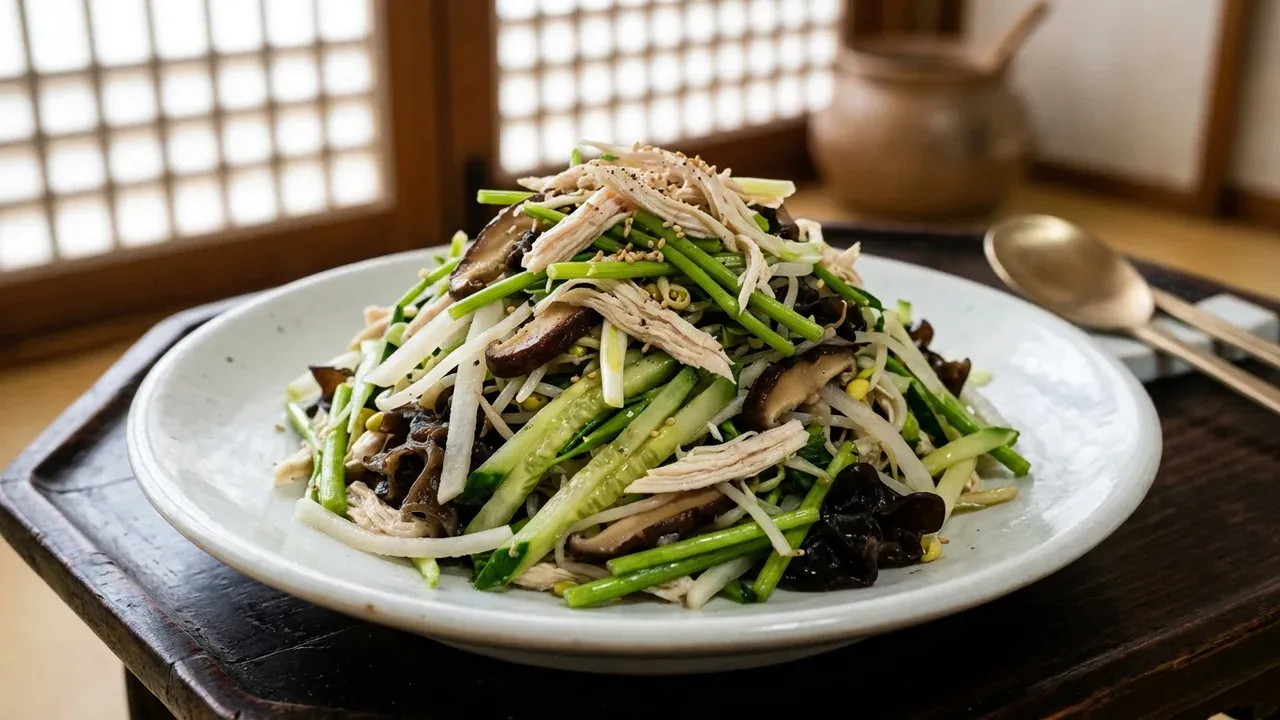
MODERN RECREATION
Modern Adaptation Proposal
Ingredients
Instructions
- Poach the chicken in boiling water until fully cooked through to the center (internal temperature of at least 75°C / 165°F for 1 minute). Remove, let cool, and shred finely into threads. Strain and reserve 150mL of the cooking broth.
- Rehydrate the dried wood ear mushrooms in warm water, trim the tough base, and slice into thin shreds. Cut the cucumber, daikon, shiitake, and scallions into thin strips about 3 to 4 cm long (the 1-chi length specified in the original text).
- Briefly blanch the dropwort and mung bean sprouts in boiling water, plunge into cold water, squeeze out excess moisture thoroughly, and cut to match the length.
- Heat small amounts of sesame oil and soy sauce in a skillet over medium heat. Sauté each vegetable group individually for 1 to 2 minutes over high heat—starting with light-colored produce (daikon, sprouts), followed by green vegetables (cucumber, scallion, dropwort), and finally mushrooms (shiitake, wood ear)—transferring each to a large platter to keep colors vibrant.
- Arrange the individually sautéed vegetables, mushrooms, and shredded chicken in neat, multicolored sections on a large communal serving platter (or toss gently together).
- In a small saucepan, combine the 150mL of reserved chicken broth, 2 tsp soybean paste, and 1 tsp soy sauce. Bring to a simmer, whisk in the flour slurry to thicken into a glossy sauce, then take off heat and stir in 1 tsp sesame oil.
- Ladle the warm savory sauce evenly over the arranged ingredients on the platter, and finish by dusting with grated fresh ginger and freshly cracked black pepper.
HISTORICAL RECORD
Historical Sources and Evidence
These sources provide historical context. They do not necessarily support the quantities or cooking times in the modern adaptation.
Statements supported by sources
Recorded under the heading 'Japchae' in the c. 1670 cookbook Eumsik Dimibang by Lady Jang Gye-hyang, specifying that cucumber, radish, daikon, shiitake, pine mushrooms, rock tripe, and mung bean sprouts be used raw, while bellflower root, wood ear, dried gourd, shepherd's purse, water dropwort, scallion, fatsia shoots, bracken fern, wild angelica leaves, winter melon, eggplant, and pheasant meat be boiled and shredded fine like threads.
The source instructs cutting ingredients into thin strips of 1 chi (approx. 3cm), sautéing each color group separately in seasoned oil and soy sauce, arranging them on a large platter, pouring over a warm thickened sauce made from pheasant broth, soybean paste, and wheat flour, and finishing with pepper, flour, and ginger.
The text notes that winter melon should be briefly blanched and can be dyed red using cockscomb flowers or wild grape juice to produce an attractive color.
Inference and interpretation
- The term 'jin-garu' is widely interpreted by culinary historians as wheat flour used as a thickening agent, consistent with the classical 'nureumi' technique of Joseon aristocratic cuisine, although some commentators interpret it as concentrated soy powder.
- 'Jeon-jireong' is interpreted as soy sauce fried with sesame oil or clear aged soy sauce.
- While later cultural historians frequently describe Japchae as an embodiment of the Korean 'five cardinal colors' (Obangsek), the 17th-century text itself provides practical culinary instructions to sauté colored ingredients separately rather than formulating an explicit philosophical framework.
- Sweet potato starch glass noodles (dangmyeon), which characterize modern Japchae, were not introduced until a factory was established in Sariwon, Hwanghae Province in 1919; they did not exist in 17th-century Joseon.
Modern adjustments
- Chicken breast or thigh is substituted for pheasant, which is difficult to source for modern home cooks.
- Rare or seasonal wild greens (bellflower root, fatsia shoots, angelica, wild mushrooms, winter melon) are omitted in favor of readily available supermarket produce: cucumber, daikon, shiitake, wood ear, dropwort, scallion, and mung bean sprouts.
- The sautéing sequence (light-colored produce first) and precise timings (1–2 minutes) are modern culinary adaptations designed to keep colors distinct in domestic cookware.
- Food safety: Ensure poultry reaches an internal temperature of at least 75°C (165°F) for 1 minute to prevent foodborne illness, and sanitize cutting boards after handling raw meat.
- Allergen information: Contains chicken, wheat, soy, and sesame.
Sources and references
- 閨壺是議方(음식디미방)「잡ᄎᆡ(チャプチェ)」Open source: https://ko.wikisource.org/wiki/%EC%9D%8C%EC%8B%9D%EB%94%94%EB%AF%B8%EB%B0%A9/%EC%A1%B0%EB%A6%AC%EB%B2%95
Primary source text. Oldest surviving Korean-language cookbook, written c. 1670 by Lady Jang Gye-hyang. Inspected the electronic transcription of 'Japchae'. Referenced original manuscript facsimiles held at Kyungpook National University and Baek Du-hyeon's 2006 critical edition. Physical manuscript was not directly inspected.
- USDA FSIS, Chicken from Farm to TableOpen source: https://www.fsis.usda.gov/food-safety/safe-food-handling-and-preparation/poultry/chicken-farm-table
Modern food safety guidance: minimum internal cooking temperature of 165°F (74°C) for poultry, prevention of cross-contamination from raw meat, and thorough cleaning of cutting surfaces.
- 厚生労働省「カンピロバクター食中毒予防について」Open source: https://www.mhlw.go.jp/stf/seisakunitsuite/bunya/0000126281.html
Modern household hygiene guidance: cook poultry until the center reaches at least 75°C for 1 minute, and prevent secondary contamination by cleaning tools with boiling water.
Image credits and sources
© History Meshi (AI-generated recreation image / AI生成による再現イメージ)
Source: Modern adaptation concept based on Eumsik Dimibang (c. 1670) / 『閨壺是議方(음식디미방)』(1670年頃)に基づく現代向け再現案の料理イメージ
License: Original site asset (not an actual cooking or historical source photograph / 実調理・史料写真ではありません)