England, 18th century (1774 edition)
Yorkshire Pudding (Hannah Glasse, The Art of Cookery, 1774 edition)
Based on "A Yorkshire pudding" in Hannah Glasse's 18th-century English cookbook The Art of Cookery Made Plain and Easy (1774 edition), this article covers a batter of milk, eggs, flour and salt baked in meat dripping. It separates the documented method from the quantities and times set for a modern oven.
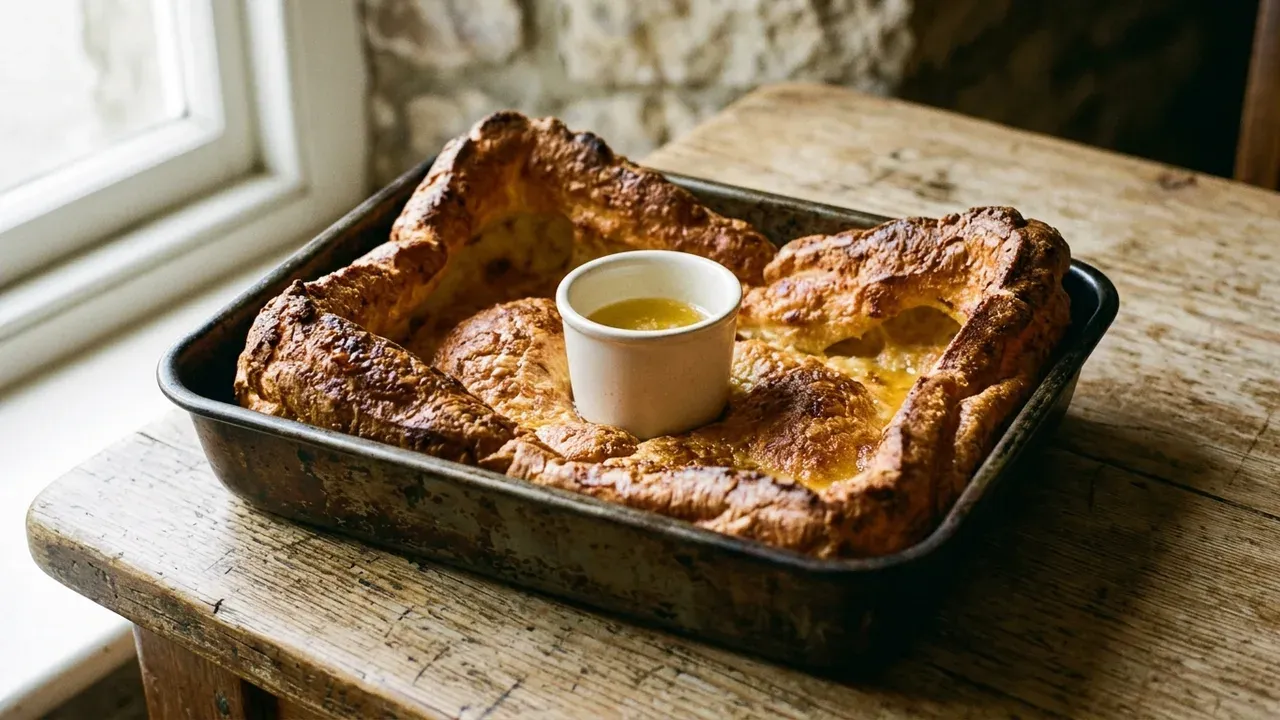
MODERN RECREATION
Modern Adaptation Proposal
Ingredients
Instructions
- Do not wash the eggs; crack them into a separate small bowl to remove any shell, then mix 2 eggs, 250mL milk and 1g salt in a bowl. Wash hands and utensils that touched raw egg straight away. Sift in 100g flour and mix until no lumps remain, to a batter about as thick as pancake batter (the source gives no flour quantity, so the thickness is a guide). Rest it at room temperature for no more than 30 minutes; if it needs longer, refrigerate it.
- Preheat the oven to 220°C. Put 30g beef dripping or lard in an ovenproof metal square or round tin (about 18–20cm) and heat it in the oven for 5–10 minutes, until the fat is hot and thin but before it smokes.
- Using thick oven mitts, take out the hot tin and pour in the batter all at once, keeping your face and arms back from splatter (it will sizzle). Return it to the oven immediately. Watch for hot fat spitting and for burns from the tin and handles, and never add water to the fat.
- Bake 25–35 minutes without opening the door for the first 20. The edges should rise, the whole surface should turn a deep golden brown and the centre should be set (as the hygiene target, at least 75°C in the centre for 1 minute or more). It does not need to rise or colour evenly. If the centre is still liquid, bake a few minutes longer.
- When done, tilt the tin and carefully pour off the excess hot fat into a heatproof container (the source also says to drain the fat), then slide the pudding onto a plate at once. Melt 15g unsalted butter in a small heatproof cup in a microwave or water bath and set it in the middle. Guard against burns from steam, hot fat and the tin.
- Do not leave the cooked pudding at room temperature for over 2 hours (or 1 hour above 32°C); move leftovers to shallow containers and refrigerate promptly at 4°C or below. Reheat to at least 75°C in the centre for 1 minute or more.
HISTORICAL RECORD
Historical Sources and Evidence
These sources provide historical context. They do not necessarily support the quantities or cooking times in the modern adaptation.
Statements supported by sources
Chapter 7, "Of Puddings", of Hannah Glasse's The Art of Cookery Made Plain and Easy (1774 edition) contains "A Yorkshire pudding". It calls for a quart of milk, four eggs and a little salt, made up with flour into a thick batter like pancake batter (no flour quantity is given).
The method: have a good piece of meat roasting at the fire; put dripping in a stew-pan and, when it boils, pour in the batter and bake it by the fire. When nearly done, an upturned plate is placed in the dripping pan so the dripping is not blackened, and the pan is set on it under the meat so the meat's fat drips onto the pudding and the heat of the fire browns it.
When the meat is done and sent to table, all the fat is drained from the pudding, it is set on the fire again to dry a little, then slid as dry as possible onto a dish. Melted butter is put in a cup and set in the middle of the pudding. The book calls it an excellent good pudding and says the gravy of the meat eats well with it.
Inference and interpretation
- This article inspected the Wikisource electronic transcription of the 1774 edition; character-by-character collation against the 1747 first edition or page images was not performed. The 1774 edition appeared after Glasse's death and is not confirmed to have the same text as the first edition. The origin of the dish name and earlier records were not examined.
- No flour quantity is given in the source, and "thick like pancake batter" leaves room for interpretation. The transcription reads "night enough", which is understood as "nigh enough" (close enough), though a transcription or textual variation is possible.
- The source bakes the batter in a pan with meat dripping beside a fire where meat is roasting, which differs from a domestic convection oven. The text does not describe the batter rising high, so it cannot be assumed from the text alone that the result matches the modern puffed Yorkshire pudding.
Modern adjustments
- This untested proposal for 2–3 servings uses 100g flour, 2 eggs (about 120g in shell), 250mL milk, 1g salt, 30g fat and 15g melted butter. It is not a straight scale-down of the source's quart of milk and four eggs, and the flour quantity is set for modern home cooking. The meat is not roasted and the gravy is omitted.
- The proposal bakes in a domestic oven at 220°C in an 18–20cm metal square or round tin. The 10 minutes of preparation, up to 30 minutes of resting (optional), 5–10 minutes of heating the tin and 25–35 minutes of baking are guides; bake time, rise, colour and how firmly the centre sets are untested.
- Food safety (modern guidance): do not wash eggs, keep them refrigerated and never eat batter-based egg dishes undercooked. Verify at least 75°C in the centre for 1 minute or more (the US USDA benchmark for egg dishes is 71°C; this article uses 75°C for 1 minute or more in all five languages). Do not leave egg dishes at room temperature for over 2 hours (or 1 hour above 32°C); refrigerate leftovers in shallow containers at 4°C or below and reheat to at least 75°C in the centre.
- Allergens and burns: it contains egg, milk and wheat, and beef dripping or lard is an animal fat. Check actual product labels. Hot fat spits easily and the tin and handles get very hot, so use oven mitts and never put water on the fat.
Sources and references
- Hannah Glasse, The Art of Cookery Made Plain and Easy(1774年版)第7章「Of Puddings」「A Yorkshire pudding」(Wikisource電子翻刻)Open source: https://en.wikisource.org/wiki/The_Art_of_Cookery_Made_Plain_and_Easy_(1774)/Chapter_7
Electronic transcription of the primary text. Confirmed the full entry "A Yorkshire pudding" in Chapter 7 (a quart of milk, four eggs and a little salt made into a thick batter with flour; baked in a pan of meat dripping by the fire; set under the roasting meat so its fat drips on it for browning; when the meat is done, drain the fat, slide the pudding onto a dish and set a cup of melted butter in the middle; the meat gravy goes well with it). Not collated against the 1747 first edition or page images; the 1774 edition appeared after Glasse's death and is not confirmed to match the first edition.
- USDA FSIS, Shell Eggs from Farm to TableOpen source: https://www.fsis.usda.gov/food-safety/safe-food-handling-and-preparation/eggs/shell-eggs-farm-table
Modern egg safety guidance: keep eggs refrigerated, cook until white and yolk are firm, cook egg dishes to 160°F (71°C) internally, cool leftovers promptly in shallow containers, never leave refrigerated eggs out more than 2 hours, and do not wash eggs at home. This article applies a 75°C-for-1-minute target consistently in all five languages.
- FoodSafety.gov, Safe Minimum Internal TemperaturesOpen source: https://www.foodsafety.gov/food-safety-charts/safe-minimum-internal-temperatures
Modern safe internal temperature chart: confirmed that egg dishes such as frittata and quiche reach 160°F (71°C) and that raw eggs are cooked until yolk and white are firm.
- 厚生労働省「家庭での食中毒予防」Open source: https://www.mhlw.go.jp/stf/seisakunitsuite/bunya/kenkou_iryou/shokuhin/syokuchu/01_00008.html
Modern food safety guidance (Points 2–6): hand and utensil washing, heating the centre to at least 75°C for 1 minute or more, rapid shallow-container chilling and thorough reheating. Not historical cooking conditions.
- FoodSafety.gov, 4 Steps to Food SafetyOpen source: https://www.foodsafety.gov/keep-food-safe/4-steps-to-food-safety
Modern hygiene guidance: Clean, Separate and Chill (refrigerate at 4°C or below, and avoid leaving food out over 2 hours, or 1 hour above 32°C).
- FDA, Food Allergies: What You Need to KnowOpen source: https://www.fda.gov/food/buy-store-serve-safe-food/food-allergies-what-you-need-know
Modern allergen guidance: referenced for checking labels for major allergens such as egg, milk and wheat. Legal labelling categories vary by country.
Image credits and sources
© History Meshi (AI-generated recreation image / AI生成による再現イメージ)
Source: Modern adaptation concept based on Hannah Glasse's The Art of Cookery (1774 edition) / グラス『The Art of Cookery』1774年版に基づく現代向け再現案の料理イメージ
License: Original site asset (not an actual cooking or historical source photograph / 実調理・史料写真ではありません)